Comparing Water Systems to Find Your Best Fit
Do I Really Need to Filter My Water?
Do you want me to just cut to the chase? Our tap water in the US is not safe to drink. We are going on 175 years, post-Industrial Revolution now, of dumping chemicals into our water supply – none of which belong in our bodies.
Nothing caused my husband and I to realize the importance of toxin-free water more than my cancer diagnosis in 2008. We started learning that practically EVERYTHING in our modern world can lead to an environment that encourages cancer growth including our chemical-laced public tap water.
In the U.S. and other developed countries clean water and proper sanitation has been essential to the decline in infectious disease incidence starting in the early 20th century. This has been significant in the overall decline of mortality, but with this addition of chemicals to our water supply to kill off pathogens has come a different problem – the cumulative effect of toxic chemicals in our drinking water and an increase in chronic disease.
Because of this (in addition to our diet, lifestyle choices and environmental factors,) chronic diseases such as cancer, inflammatory diseases like asthma, and other disorders have become prevalent and considered normal in our culture.
Chemicals from automobiles, lead, chromium, viruses, bacteria (including anthrax and salmonella,) and pharmaceutical residue dumped or urinated into the water supply are all easily detectable in our water supply (and our blood tests) in addition to the things that are intentionally ADDED to our water such as chlorine and fluoride.
Comparing THREE Popular Options: Boroux Filters, Aquatru Reverse Osmosis, Water 4 Life Alkaline Ionizer
This guide will help walk you through our own decision-making process for the right water filter for our family. I have had experience with all three units over the years, so I’ll share my honest opinion and decision making as we go.
| Filter |
Removes Fluoride |
Removes PFAS |
Alkalizes Water |
Installation |
Price Range |
Maintenance |
| Boroux |
✅ Yes |
✅ Yes |
❌ No |
None (gravity) |
$$ |
Low |
| AquaTru |
✅ Yes |
✅ Yes |
✅ Yes
❌ No |
Countertop plug-in or under counter |
$$-$$$ |
Moderate |
| Water4 Life Genesis Alkaline Ionizer |
✅ Yes |
❌ Not Verified |
✅ Yes |
Countertop, gravity or under-sink options |
$$$ |
Low–Moderate |
My family’s journey into better health has been a long one, beginning with my cancer diagnosis in 2008 and our decision to address it using non-toxic methods. The need to find a better water filter became one of our first changes.
At the point of my diagnosis we were using a simple Brita hand-held filtering container. We learned that although it removed chlorine and odor, it did not remove many of the other more harmful substances like PFAS forever chemicals, pharmaceutical runoff, fluoride, or microplastics.
After much research and the persuasion of a few people we respected, we purchased an alkaline water ionizer. We loved and enjoyed the heavenly tasting water from this system for 7 years, but when it stopped working in 2016, we knew we needed to do some new research. Buying another alkaline ionizer would be expensive and there were many other options available. There were also some questions on how thorough the contaminant removal and filtering certifications were.
After much debate we now use Boroux gravity-fed water filters and this post discusses why we made that choice. 🙂
I also include the two other options we compared them against and why those may be a better option for you depending on your circumstances. There’s also some nuance with the relationship between the popular Berkey brand filters and Boroux filters, and I will discuss that as well.
Can you explain the relationship between Boroux and Berkey?
Some of you may know that I recommended Berkey water filters for years — and for good reason. They are identical to all of the qualities of the Boroux filters I spoke about above. In 2022, the Environmental Protection Agency (EPA) slapped a “stop production order” on Berkey for claims made about its ability to filter microorganisms. In order to do so, they would have to be classified as a “pesticide” and they did not have this type of certification. This put many Berkey distributors out of business and made it very difficult to find replacement filters. Today they are no longer in production and any Berkey black filters still for sale are inventory produced prior to the EPA stop-sale ban.
The family who owns BerkeyFilters.com, (who I purchased my Berkey filters from,) decided to pivot and launched Boroux independently from Berkey. This means they now have full control over the design, manufacturing, and testing of their filters. I love this company because they have sought out ongoing testing and have received multiple certifications that Berkey never underwent. They are essentially a better, more transparent Berkey filter. Same filter technology (carbon/coconut shell), but they aren’t making claims without backing it up with testing and certification.
Boroux filters are fully compatible with old Berkey systems, so if you already have a Berkey unit, you can use Boroux filters perfectly (we do.)
💧 What We Use: Boroux Gravity-Fed Water System
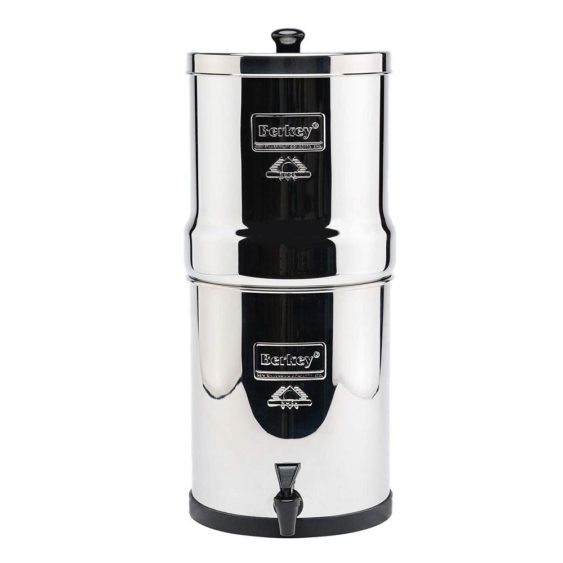
The Boroux water filter system is a non-electric, portable, gravity-fed water filtering system that filters 99%+ of contaminants such as viruses, bacteria, environmental pollutants, pesticides, and pharmaceuticals from our water supply.
We have used Boroux/Berkey black gravity-fed filters since 2016 and have found this system to be the easiest, most thorough, and most cost-effective solution to filtering our family’s water.
8+ Reasons I Love Boroux Water Filters
#1. Filtering Capabilities and Certifications:
As I mentioned above, very little compares to the filtering capabilities of the Boroux water filter system. You can read the third-party reports of their filtering capabilities to get started on your research below. Just reading them again makes me so thankful it is what we filter our water through everyday. They are also one of the most highly and thoroughly certified water filters you can buy. Boroux filters are tested by ISO/IEC 17025:2017 accredited laboratories and adhere to NSF/ANSI Standards 42, 53, and 401. Here’s a quick rundown of what it removes and percentages:
🧪 BOROUX Foundation™ Filter Contaminant Removal Chart (Source)
| Contaminant Category |
Examples |
Reduction Rate |
| Heavy Metals |
Lead, Mercury, Cadmium, Chromium, Uranium, Cesium |
Up to 99.36% |
| Pharmaceuticals |
Ibuprofen, Naproxen, Phenytoin, Carbamazepine, Meprobamate, Trimethoprim, Atenolol, Estrone, Trichloroacetic Acid |
Up to 99.5% |
| Pesticides & Herbicides |
Atrazine, Alachlor, Carbofuran, Metolachlor, Glyphosate, Methoxychlor, Linuron, Endrin |
Up to 99.95% |
| Volatile Organic Compounds (VOCs) |
Chloroform, Carbon Tetrachloride, Ethylbenzene, Chlorobenzene, Bromodichloromethane, Bromoform |
Up to 99.97% |
| Disinfection Byproducts (DBPs) |
Trihalomethanes (THMs), Haloacetonitriles, Haloketones, Bromochloroacetonitrile |
Up to 99.68% |
| PFAS (Forever Chemicals) |
PFOA, PFOS, PFNA, PFHxS, PFHpA, PFBS, PFDA |
Up to 99.6% |
| Microplastics |
BPA, Nonylphenol |
Up to 98.9% |
| Fluoride (with added fluoride filter) |
Fluoride |
Up to 99.9% |
| Chlorine & Chloramine |
Chlorine, Chloramine |
Up to 99% |
| Particulates (Class I) |
Sediment, Rust, Sand |
Up to
98.9% |
#2. PRICE
Compared to other options for filtering water, you cannot beat the Boroux on price.
A stainless steel Boroux system has no mechanical parts and will last a lifetime with a ~$300 investment + filters every few years (if you need fluoride filters they will need to be replaced more frequently but we will get to that below.)
Each black Boroux foundation filter only needs to be replaced every 12-months (or technically every 6,000 gallons.) Each Boroux liter of water costs an average $0.02 per gallon. Compare this to $0.20 per gallon in a Brita filter and up to $2.00 per gallon for bottled water!
Over the course of 3 years, the Boroux filter system will only cost you your initial ~$300 while other water systems you have to keep buying filters. For a Brita filter this adds up to around ~$500 for three years (and counting!) Bottled water will cost you hundred per month for a family.
💰 Daily Cost Comparison (1 gallon/day)
| Option |
Cost per Gallon |
Daily Cost
(1 person) |
| Boroux |
$0.023 |
$0.02 |
| Brita |
$0.20 |
$0.20 |
| Bottled |
$1.00–$2.00 |
$1.00–$2.00+ |
Compared to ~$3,500 alkaline or hydrogen water systems, $8,000+ all-house systems, and ~$350+ reverse osmosis systems that require twice yearly filter replacement and often professional installation, you cannot compete with the simple investment in a gravity-fed system.
You also don’t have to worry about anything breaking or how long your warranty lasts.
#3. Filters Last a Long Time!
I mentioned this above, but each Boroux filter lasts 6,000 gallons. A set of 2 (which is typical use) is 12,000 gallons! Depending on how much water you or your family uses, these can last longer than 12 months, although they are warrantied for only a year and that is when the company recommends replacement. If filtering slows down, simply remove your filters and “prime” them by scrubbing them gently and running water through them again using the priming tool (“blue” or “tan”) – included with your filters.
This refreshes flow and maintains performance. Clean the stainless steel chambers with water and vinegar monthly (1 to 3 ratio vinegar to water,) and scrub the filters every 6 months or so.
We aren’t perfect on this maintenance routine, but it’s worth it to protect our investment!
#4. Taste of Water
I will be honest here. I loved the taste of my alkaline water ionizer. Boroux does not win in this category because the pH of the water is not altered (it will stay the pH of your tap water,) and it’s not ionized. But the water still tastes so clean and fresh! People come over to our house and comment all the time on how great our water tastes.
This makes me more attuned to the horrible, chlorine-taste of water whenever I’m out at a restaurant or someone else’s house (even if they have a Brita or another kind of filter!) I can especially taste the plastic leaching in certain bottled waters!
#5. Easy to Refill
Different kitchen setups will create different strategies for refilling your Boroux system, but I found the best thing is to keep it close to your sink so you can refill it with your extendable water sprayer in your kitchen. I can extend mine up to the top of the unit and let it sit there until the water is at the top. We do this every night as we’ve found that is a good rhythm to making sure we have clean, filtered water for the entire next day!
Another option is to fill a large Vitamix or blender container or another water pitcher with water and make as many refill trips as needed to refill your Boroux system.
#6. No Need for a Plumber + Easy Setup + No Electricity Needed + Better for the Environment
That pretty much says it all. For the first 7 years after my cancer diagnosis we had an alkaline water system because someone told us that it would help us with fighting cancer and my acidic internal environment by alkalizing it.
This system required special installation and if the power was out, we couldn’t use our machine and didn’t have clean water.
The same goes with a reverse osmosis system, many of which also require fancy installation to a degree and wastes ~2 gallons of water per 1 gallon of filtered water it makes.
We are grateful for the simplicity and steady-nature of the gravity-fed, non-electric Boroux system.
And I am especially grateful for the amount of plastic bottles the Boroux system helps reduce, especially since latest reports are that only 9% of our plastic actually gets recycled (with the rest going to landfills.) 2025 preliminary reports are showing that number closer to 5%.
#7. Filters Fluoride
Even though updated science is consistently showing that internally consumed fluoride today has no benefit in overall dental health, 70% of municipal water plants in the US still add fluoride to their water supply.
Not only does evidence show that internally ingested fluoride does little to help teeth, it is an extremely toxic substance linked to many health issues including endocrine disorders, allergies and cancer. (Source)
Most developed countries including Japan and 97% of Europe do not fluoridate their water. It is an outdated practice based on outdated science and needs to be addressed.
You can check your area’s fluoride status HERE. If it shows that fluoride is added to your water, you will definitely want to consider adding a Boroux fluoride filter to your system when you purchase it. These simply attach in the bottom container to the top black filters in the above Boroux container and need to be replaced every 1,000 gallons. I found my county’s fluoride additive percentage to be above even government recommendations. 🙁
The only modern studies to show benefits from fluoride have always been in topical fluoride used as a treatment in dental offices and perhaps some evidence that topical fluoride toothpaste has helped.
#8. Comes in 3 Colors to Matchy Matchy your Kitchen!
This is such an added perk with the Boroux! If you prefer a matte black or matte white finish instead of the standard stainless steel, you can add it for an additional $20! They are beautiful units!
Boroux Cons: (that are minor in my opinion…)
So, not everything’s perfect and this wouldn’t be a realistic or honest portrayal of my experience with the Boroux system if I didn’t have a few opinionated cons. Here are a few things that were I wish were a bit different (but honestly just reflect on my lazy tendencies…😉
- Priming the Filters- All water systems require some sort of priming, so you really can’t get away from this. Boroux makes it easy though! All filters come with a priming tool which makes the process super easy!
- Sometimes it needs a babysitter– So, unlike other filters, the black Boroux filters need to be consistently used or they dry out and will need to be re-primed. This is true if you are going on more than a weekend long vacation. Check out the storage guidelines below.
Boroux Official Guidance on Storage:
-
- Weekend trips (a few days): No special prep needed—filters in the system are fine. If flow slows a bit upon return, a quick prime is all that’s needed.
- Away 7–10 days: Remove filters from the chamber, place them in a zip‑top bag with a little water, and store in the fridge (ideally the door) to keep them moist—Boroux notes they can stay in the fridge for up to 30 days.
- Away long-term (>30 days): Let the filters air-dry completely (3–5 days), then store dry in their packaging—dry storage prevents mold and odor issues.
- Cleaning your Boroux – Just like with anything, every month or so I clean out both Boroux top and bottom reservoirs with vinegar and water spray and some paper towels or a Norwex cloth. Sometimes I go two or three months and have never noticed a change in taste or smell.
- Its LARGE presence – Whenever new people come to my house they are immediately drawn to asking questions about my water system. You can see what it looks like in the picture above. It is a LARGER presence on your counter. 🙂 I personally like it because my health journey and lifestyle is something I enjoy talking about!
- Having to manually refill- I don’t mind this so much because we just stick to the routine of doing it every night before bed and checking at lunchtime, but I imagine for someone just used to grabbing water from the tap, this would be annoying. But it’s SO worth it to me knowing I’m getting the BEST water.
- Only a few sizes available – Boroux is currently only available in two sizes: 3 gallon and 1.5 gallon. Berkey still does sell their larger-sized units (4.5 and 6 gallon units) if 3 gallons isn’t large enough for you. Another tip is to just buy the 3 gallon Boroux unit and get 4 filters so your water filters faster and then make it your routine to refill twice a day.
Where Can I Buy a Boroux Water Filter System?
You can purchase a complete 3-gallon Boroux Water Filter system starting at around ~$350. Shipping is FREE. 🙂 If you are just looking for replacement filters for your existing Berkey unit click HERE.
For our family of 8, we go through a day’s worth of water (~6 gallons) using an old Berkey 6-gallon model in about a day. The 3-gallon Boroux model would need to be refilled twice a day for us.
***Make sure to add on your fluoride filters if needed!
(pic)
💧 Another Great Option: AquaTru Reverse Osmosis System
The AquaTru is a plug-in, reverse osmosis (RO) water filtration system that removes 82+ contaminants, including lead, fluoride, PFAS, chlorine, and microplastics, using a four-stage purification process. Its countertop model offers a clean, efficient alternative to under-sink RO units – without requiring a plumber or permanent installation.
This is a great choice for those who prefer easy installation with the added instant fluoride removal and purification of RO technology. Under sink options are also available but require a plumbing expert for installation.
4 Reasons to Consider the AquaTru RO Filter
#1. Reverse Osmosis + Certified Performance (Source)
AquaTru’s 4-stage RO system removes the most common and dangerous tap water contaminants, including:
| Contaminant Category |
Examples |
Removal Rate |
| Heavy Metals |
Lead, Chromium-6, Copper, Cadmium |
97%–99.1% |
| Fluoride |
Fluoride |
Up to 93.5% |
| Chlorine/Chloramine |
Chlorine, Chloramine |
96.6%–97.2% |
| PFAS |
PFOA, PFOS |
97.5%+ |
| Pharmaceuticals |
BPA, Naproxen, Meprobamate |
Up to 99% |
| VOCs |
Chloroform, Toluene |
Up to 97% |
| Nitrates/Nitrites |
Nitrates, Nitrites |
Up to 86.7% |
It is NSF-certified to Standards 42, 53, 58, 401, and P473 – even more than the Boroux above.
A big perk of the Aquatru is not having to fuss with adding additional fluoride filters. Reverse osmosis machines naturally do that. With Boroux and alkaline water machines you will need to purchase additional filters and install them.
#2. Easy Setup, No Plumbing Required
One of the things I love most is that AquaTru sits right on your countertop and doesn’t require installation. You just fill the tap water tank, press a button, and it filters your water into a separate tank, ready to pour. It plugs into a standard outlet and fits in most kitchen spaces. It’s plug and go! It wins the “ease of set-up” award over Boroux.
#3. Filter Replacement is Easy
AquaTru uses three compact filters that snap in and out – no tools needed.
- Pre/Carbon Filter: lasts 6 months
- Reverse Osmosis Filter: lasts 2 years
- VOC Carbon Filter: lasts 1 year
The machine will let you know when it’s time or you can set a calendar alert. Compared to other RO systems that require 2–4 filter changes a year, AquaTru is refreshingly low maintenance.”
#4. Alkaline Water is Also an Option
For a marginal additional fee you can grab the alkaline water unit in both of the countertop sizes that AquaTru offers.
AquaTru RO Cons: A few things I don’t like…
- Needs Electricity: I have perhaps an irrational fear of the power going out and not being able to get fresh, filtered water, but this is a legitimate concern for some. I prefer the Boroux water system to the Aquatru for this reason.
- Filter replacement often: There are 3 filters and you’ll need to keep track of when they need to be replaced.
- Wastewater: Although much more efficient than under-sink RO systems, AquaTru still produces some wastewater, about 2 gallons of wastewater per 1 gallon of filtered water.
- Appearance: Its white plastic presence in my otherwise stainless steel and black kitchen is not a deal breaker, but I like the stainless steel, or white or black matte appearance of the Boroux.
- Minerals Removed: Like all RO systems, AquaTru removes minerals from the water. If you want them back in, you can add mineral drops or use AquaTru’s Mineral Boost add-on.
- Refilling often: The largest-sized countertop Aquatru (or any reverse osmosis machine) I have seen doesn’t even go up to a gallon. Compared to the 3-gallon Boroux, you would be filling up more than 3x as much! This would be a lot for our family. An undersink, faucet model would be a better choice if choosing RO.
Where to Buy:
Shop the AquaTru Countertop RO system. Check for sales HERE.
***AquaTru also has under counter options and alkaline options that I have NOT tried on their website.
(pic)
💧 Water4 Life Genesis Alkaline Filter
The Water4Life Genesis is a high-end, electric alkaline water ionizer that connects directly to your kitchen faucet and produces both alkaline and acidic water through a process called electrolysis. The Genesis uses advanced filtration combined with powerful ionization to adjust the pH of your water, remove contaminants, and produce antioxidant-rich alkaline water for drinking, cooking, and wellness.
We used a Genesis-style ionizer as our family’s main water system for over seven years — especially during the early years of my healing journey — and I have a lot to say about the pros, the cons, and the ideal use cases for a system like this.
7+ Reasons I Love the Genesis Alkaline Water Ionizer
#1. Ionized, Alkaline Water with Antioxidants
The primary benefit of an alkaline ionizer like the Genesis is that it doesn’t just filter water – it transforms it. Using electrolysis, the machine separates water into acidic and alkaline streams, and you can choose the pH level you want. This gives you control over water pH, ranging from about 3.0 (acidic) to 10.5+ (alkaline) depending on your local tap water.
The alkaline water produced contains molecular hydrogen, which is a powerful antioxidant and may support cellular health, hydration, and detoxification. The acidic water can be used for cleaning, skin care, and disinfecting.
#2. Built-In Filter for Contaminants
Before ionization, the Genesis runs your water through a high-quality internal filter. This reduces:
- Chlorine
- Chloramine
- Sediment and rust
- Some VOCs and organic contaminants
While it doesn’t filter as thoroughly as a reverse osmosis or gravity-fed system like Boroux, it does improve taste and removes the basics. Many families choose to pre-filter their water (especially for fluoride or heavy metals) using a whole house or under-the-sink filtering system.
#3. Easy and Instant Alkaline Water
Once installed, the Genesis makes it easy to get alkaline water on demand. You simply press a button on the touchscreen panel to select your desired pH level, and water flows immediately. A genteel voice chimes in “Alkaline water in 1st step” and you can adjust the level for your needs.
There’s no waiting like with gravity systems, and no refilling of tanks. This is great for large families, high water usage, or people who want alkaline water throughout the day for tea, smoothies, and meals.
#4. Build Quality and Warranty
Genesis ionizers are designed and made in Korea to last. The internal plates (which perform the electrolysis) are solid titanium coated with platinum, and they’re self-cleaning to avoid mineral buildup.
They also come with a 5-year warranty and 60-day money back guarantee.
#5. Health Benefits of Alkaline + Acidic Water
While I always recommend listening to your body, many people (myself included) report improved hydration, digestion, and energy levels when drinking alkaline water consistently. It’s hard to tell with me because so much of my diet and lifestyle changed during that cancer healing season all at once, but I felt amazing drinking this water and making my daily smoothies and tea with it!
Even the acidic water output is useful! We’ve used it for:
- Cleaning produce
- Disinfecting cutting boards and sponges
- Spraying on skin breakouts or irritation
#6. Sleek on the Countertop
The Genesis is designed to sit next to your sink and looks sleek and high-tech with its touchscreen controls. While it does take up counter space, I’ve found that guests are always curious — it becomes a conversation starter, just like our Boroux system.
Installation is relatively simple for anyone comfortable with a few tools or can be done by a handyman in under an hour.
#7. No Plastic Waste + Unlimited Water
One major bonus: no more plastic water bottles! The Genesis provides a steady flow of purified, ionized water without needing to buy and dispose of bottled alkaline water — which is expensive, wasteful, and often not even truly ionized.
If your family drinks a lot of water, you’ll love the fact that the Genesis provides unlimited water on tap.
What About Fluoride?
One of the biggest downsides of ionizers like Genesis is that they do not remove fluoride. If you live in an area with fluoridated water (you can check your ZIP code here), I highly recommend using a pre-filtration system that removes fluoride — such as an AquaTru RO system or fluoride-specific gravity filters like Boroux.
Once fluoride is removed, your Genesis can still ionize the water beautifully.
Genesis Water Ionizer Cons: What I Wish Was Different
- Lack of testing certification and transparency: Although the sales page claims the machine filters out 99.99% of impurities and contaminants (not fluoride,) there is no testing or certification provided. This was standard process years ago when we bought the machine, but nowadays in order to be considered trustworthy, testing and PROOF is needed.
- Requires Electricity: If the power is out, the unit can’t ionize water.
- Installation Can Be Tricky: Some faucets may not be compatible, and you may need adapters or a plumber.
- Doesn’t Remove Fluoride or Heavy Metals: The filter is great for chlorine and taste, but not enough on its own.
- Price Tag: Most Genesis units start around $2,000–$3,500, which is an investment. However, it replaces bottled water and expensive alkaline brands over time.
Where Can I Buy the Genesis Alkaline Ionizer?
You can find the Genesis through Water4LifeUSA.com, and it’s often bundled with extra filters, pH drops, or pre-filtration add-ons. They also have good customer support and payment plans available.
Make sure to measure your faucet setup and consider whether you’ll want a pre-filter system to get the most benefit out of your Genesis.

Want to be notified when new posts are published? SUBSCRIBE to my newsletter above. 😊 Follow me on Facebook and Instagram.